
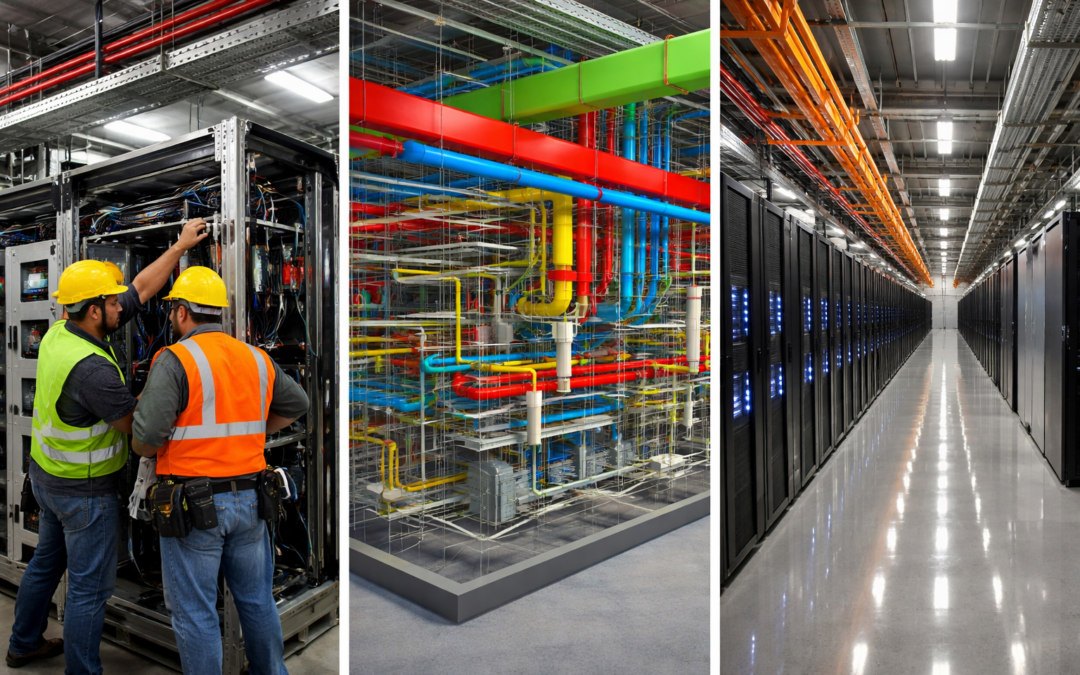
As data centers continue to expand globally, project teams are under increasing pressure to deliver facilities faster while maintaining high standards of quality and reliability. The complexity of data center infrastructure, combined with tight project schedules, makes efficient construction methods essential.
One of the most effective approaches to achieving these goals is the combination of Building Information Modeling (BIM) and prefabrication. Together, these methodologies improve construction efficiency, enhance quality control, and significantly reduce on-site risks.
The Role of Prefabrication in Data Center Projects
Prefabrication involves manufacturing building components in a controlled factory environment before transporting them to the construction site for installation. In data center projects, many critical systems—especially mechanical and electrical assemblies—can be prefabricated.
Examples include:
- MEP service modules
- Cable tray assemblies
- Pipe racks and HVAC systems
- Electrical distribution units
- Equipment support structures
By assembling these components off-site, project teams can significantly reduce the complexity of on-site construction activities.
How BIM Enables Effective Prefabrication
Prefabrication relies heavily on accurate and coordinated design information. This is where BIM plays a crucial role.With BIM, engineers and designers create highly detailed 3D models that include all architectural, structural, and MEP systems. These models provide precise dimensions and spatial relationships between components, allowing prefabricated elements to be manufactured with a high level of accuracy.Because the BIM model represents the entire facility digitally, manufacturers can produce prefabricated assemblies that fit perfectly into the overall system during installation.
Improved Construction Speed
Speed is one of the most important factors in data center construction. Every delay can affect operational timelines and business continuity.Prefabrication allows many construction activities to occur simultaneously. While the building structure is being constructed on-site, prefabricated modules can be manufactured in parallel in a factory environment.Once the modules are delivered to the site, installation becomes much faster compared to traditional construction methods. This parallel workflow helps accelerate project timelines and allows data centers to become operational sooner.
Point Cloud + BIM in Data Center Prefabrication
In data center prefabrication, combining point clouds with BIM ensures high precision and reliability by capturing the exact as-built conditions of the site and converting them into an intelligent 3D model for coordination and fabrication. Since data centers are highly dense and require millimeter-level accuracy, this approach eliminates guesswork by providing the true position of structural and MEP elements, enabling accurate off-site fabrication of components like cable trays, piping, and racks that fit perfectly during installation. It allows clash detection against real-world conditions, reduces rework and costly delays, speeds up installation, and improves planning in tight spaces. Ultimately, point cloud–integrated BIM helps deliver faster, error-free execution with greater confidence, which is critical in environments where downtime and mistakes are not acceptable.
Higher Quality and Reduced Errors
Factory-controlled environments offer significant advantages in terms of quality control. Prefabricated components are produced using standardized processes, specialized equipment, and strict quality checks.When BIM models guide the fabrication process, components are manufactured according to precise specifications. This reduces the likelihood of installation errors, misalignment, or system conflicts during construction.As a result, project teams can achieve higher levels of quality and consistency compared to traditional on-site assembly.
Enhanced Safety and Reduced On-Site Work
Construction sites often involve challenging working conditions, especially when installing complex mechanical and electrical systems. Prefabrication reduces the amount of work that needs to be performed on-site.Large assemblies can be installed as complete modules rather than being assembled piece by piece in the field. This reduces labor-intensive activities, minimizes congestion on the construction site, and improves overall safety for workers.In data center projects, where spaces can be tight and systems highly dense, this approach is particularly beneficial.
Supporting Efficient Installation and Future Expansion
Data centers must be designed with flexibility and scalability in mind. As technology evolves and demand increases, facilities often require expansion or upgrades. Prefabricated modules designed through BIM workflows can support standardized installation and easier system expansion. Modular components can be replicated or modified with minimal disruption to existing infrastructure. This approach helps ensure that data center facilities remain adaptable and efficient over their entire lifecycle.
Conclusion
The integration of BIM and prefabrication is transforming the way complex infrastructure projects such as data centers are delivered. BIM provides the accurate digital foundation required for precise design coordination, while prefabrication streamlines construction and improves efficiency. Together, these approaches enable faster project delivery, higher quality installations, improved safety, and better long-term operational performance. For organizations involved in designing and constructing modern data centers, adopting BIM-driven prefabrication strategies can provide a significant advantage in meeting the growing demand for reliable and scalable digital infrastructure.