
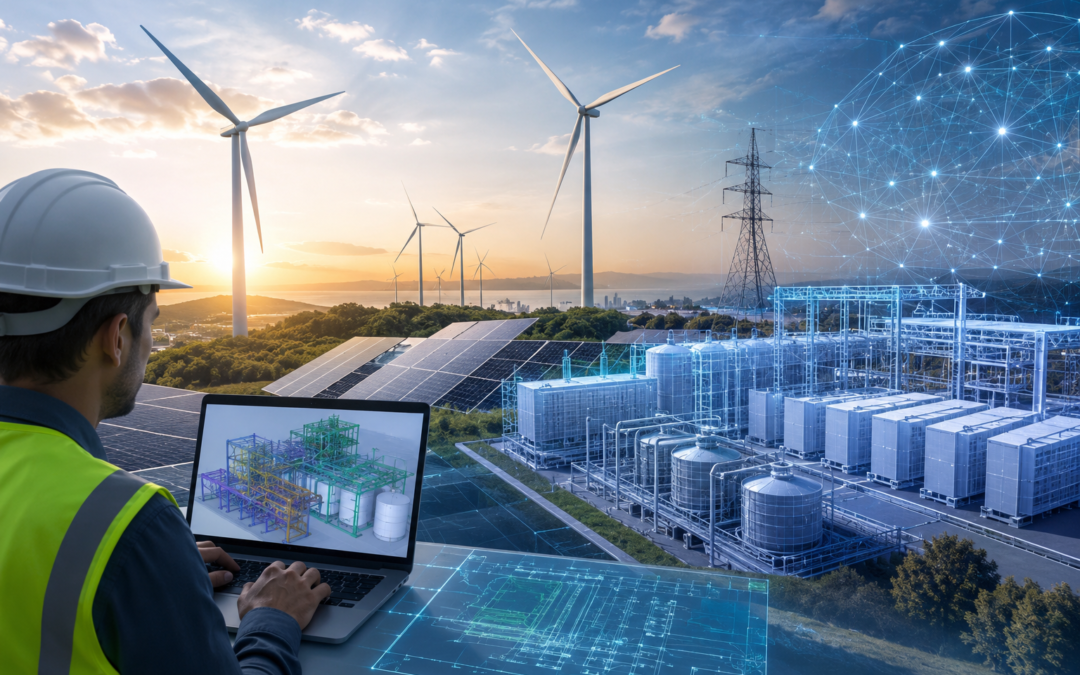
The renewable energy industry is growing rapidly across the world. From solar farms and wind energy projects to battery storage systems and substations, modern renewable infrastructure is becoming larger and more complex than ever before.
As these projects involve multiple engineering disciplines, tight schedules, and high investment costs, traditional 2D workflows are no longer enough. This is why Building Information Modeling (BIM) has become an essential part of renewable energy project delivery.
What is BIM?
Building Information Modeling (BIM) is a smart digital process that creates intelligent 3D models containing engineering, construction, and asset information.
BIM helps teams:
- Visualize projects before construction
- Improve coordination
- Detect clashes early
- Optimize construction workflows
- Manage assets more efficiently
Why BIM is Important for Renewable Energy Projects
1. Better Coordination
Renewable energy projects involve:
- Civil engineering
- Structural systems
- Electrical layouts
- Mechanical coordination
- Utility connections
BIM allows all disciplines to work in a shared digital environment, reducing communication gaps and coordination issues.
2. Clash Detection Before Construction
In large energy projects, clashes between cable routes, structures, pipelines, and equipment can cause major delays.
BIM identifies these issues before construction begins, helping teams reduce:
- Rework
- Delays
- Material wastage
- Site conflicts
3. Faster Project Delivery
Renewable energy projects often work under strict deadlines and investor expectations.
BIM improves:
- Design coordination
- Documentation accuracy
- Construction sequencing
- Team collaboration
This helps projects move faster from design to execution.
4. Improved Site Planning
Many renewable energy facilities are built on complex terrains such as deserts, hills, or remote locations.
BIM combined with terrain and GIS data helps optimize:
- Solar panel layouts
- Wind turbine positioning
- Drainage systems
- Access roads
This improves efficiency and reduces construction costs.
5. Accurate Cost & Quantity Management
BIM automatically generates quantities directly from the model, improving:
- Material estimation
- Procurement planning
- Budget control
This helps avoid costly errors and unnecessary material waste.
6. Supports Digital Twins & Asset Management
Renewable energy assets operate for decades. BIM supports long-term maintenance and operational management by creating intelligent digital asset data.
When integrated with IoT systems, BIM can evolve into Digital Twins for:
- Real-time monitoring
- Predictive maintenance
- Asset performance tracking
BIM Applications in Renewable Energy
BIM is widely used in:
- Solar Farms
- Wind Energy Projects
- Battery Energy Storage Systems (BESS)
- Substations
- Industrial Energy Facilities
Conclusion
As renewable energy projects become more advanced and technically demanding, BIM is becoming a critical tool for successful project delivery.
By improving coordination, reducing errors, optimizing construction, and supporting long-term asset management, BIM helps renewable energy companies deliver smarter, faster, and more efficient infrastructure projects.
The future of renewable energy is digital — and BIM is leading that transformation.