
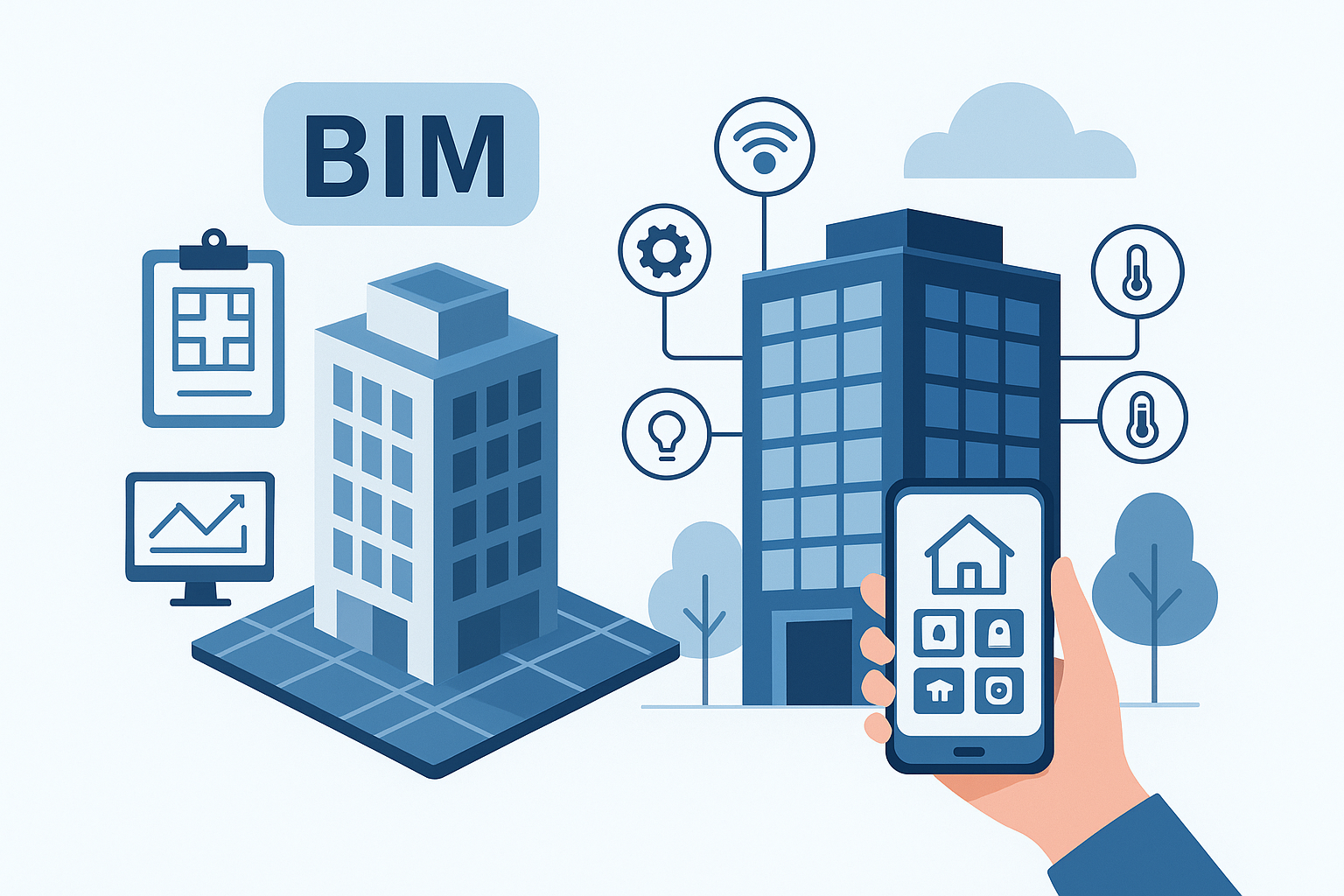
The rise of smart buildings signals a major shift in the way we design, construct, and operate our built environment. These buildings are no longer static structures—they are dynamic, data-driven ecosystems. At the heart of this transformation lies Building Information Modeling (BIM), which provides the digital foundation for designing, simulating, and managing intelligent building systems.
Beyond 3D: BIM as the Brain of Smart Buildings
Traditionally, BIM has been associated with 3D modeling. But in smart building projects, BIM becomes much more—it acts as the central brain connecting architecture, engineering, construction, and operations. By linking BIM models with IoT sensors, AI analytics, and automation platforms, smart buildings can be monitored, controlled, and optimized in real time.
Digital Twin Advantage
One of the most exciting outcomes of BIM in smart building projects is the creation of digital twins—a living, virtual replica of the physical asset. A digital twin enables facility managers to test scenarios before making changes in the real world. For example:
Simulating energy use under varying occupancy levels.
Testing emergency evacuation procedures.
Predicting system failures using sensor data.
This predictive and proactive approach is redefining building operations.
Smart Cities and BIM Integration
The impact of BIM extends beyond individual buildings. As cities invest in smart infrastructure, BIM models are being integrated with city-wide platforms. This allows urban planners to analyze how buildings interact with transportation systems, energy grids, and public spaces. In essence, BIM is becoming a cornerstone of smart city ecosystems, enabling sustainable and scalable urban growth.
Reference: European Commission Smart Cities Report (2022) emphasizes the role of BIM in integrating building and urban-scale data to support smarter, greener cities.
Occupant-Centric Design
Smart buildings are not just about efficiency—they’re about creating better human experiences. BIM allows design teams to integrate occupant-focused technologies early in the planning process, such as:
Indoor air quality monitoring systems.
Adaptive lighting and climate control.
Touchless access and personalized workspace settings.
By simulating these systems through BIM, developers can ensure that smart buildings meet the evolving needs of their occupants.
Cybersecurity in Smart Buildings
As buildings become more connected, cybersecurity is emerging as a critical consideration. BIM provides a framework to document, test, and secure digital infrastructure from the design phase. This proactive planning helps safeguard IoT devices, building management systems, and sensitive occupant data from cyber threats.
The Road Ahead
Looking forward, BIM will increasingly serve as the platform of convergence—bringing together AI, IoT, robotics, and sustainable technologies into a single integrated ecosystem. The result will be intelligent, adaptive buildings that learn from their occupants, respond to environmental changes, and optimize themselves continuously.
References & Links
- “A review of building digital twins to improve energy efficiency in the building operational stage”— This paper investigates how digital twins, built on top of BIM, can help with energy optimization, anomaly detection, continuous monitoring, and cost savings in operations. SpringerOpen
URL: https://energyinformatics.springeropen.com/articles/10.1186/s42162-024-00313-7
- “Design and Validation of a Real-Time Maintenance Monitoring System Using BIM and Digital Twin Integration”— Case study from Jeonju, South Korea; combines BIM with real-time IoT sensors to monitor environmental/structural conditions, with anomaly detection. MDPI
URL: https://www.mdpi.com/2075-5309/15/8/1312
- “European Smart Cities and Communities, Smart City Expo World Congress 2022”— Report and proceedings about how smart city solutions (which include built environment and digital systems) are being pursued across Europe. smart-cities-marketplace.ec.europa.eu+1
URL: https://smart-cities-marketplace.ec.europa.eu/news-and-events/news/2022/european-smart-cities-and-communities-smart-city-expo-world-congress-2022
- “The State of European Smart Cities”— Published February 2024; examines pilot solutions across EU cities (including in the built environment, energy, ICT, etc.), including case studies, funding, and scalable models. Climate Agency+1
URL: https://cinea.ec.europa.eu/publications/state-european-smart-cities_sl
- “Principles for Sustainable Integration of BIM and Digital Twin Technologies in Industrial Infrastructure”— Study exploring how BIM and digital twin technologies help with energy use, resource flow, operational efficiency, etc. MDPI
URL: https://www.mdpi.com/2071-1050/16/22/9885
0 Comments